PDF · 1 page · English
Succession Planning Overview
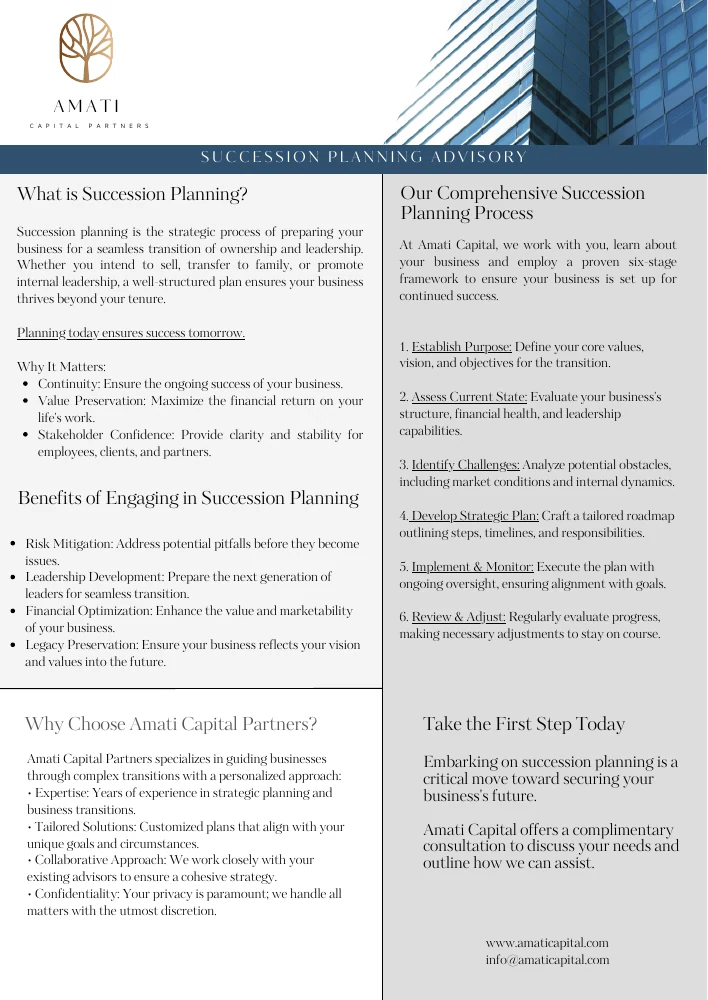
Understand succession planning and Amati’s six-stage approach.
Read the overview
Succession & Exit Planning
Amati Capital Partners helps private business owners assess transition readiness, strengthen the business behind its owner and organize a practical succession plan around their objectives, management team and available ownership options.
A confidential, 30-minute conversation with an Amati partner to understand your situation, explore your options and identify a practical next step.

A practical starting point
An ownership transition starts with decisions about your future: when you want to step back, what you want to remain involved in and what the business needs to continue performing. Those decisions deserve attention before a transaction sets the timetable.
We work with owners to turn those questions into priorities, responsibilities and a realistic sequence of work. The aim is to improve continuity and preserve choices while preparing the company for the transition that fits its circumstances.
Not sure where to start? Take the Business Health Assessment
This work is relevant to private owners considering a family transition, management buyout, third-party sale, leadership transition or eventual exit. You may have a preferred path, several possibilities or only a growing awareness that the business relies too heavily on you.
Practical resources
Start with an overview of the planning process, then use the scorecard to consider your own readiness. Both PDFs are in English.
PDF · 1 page · English
Understand succession planning and Amati’s six-stage approach.
Read the overviewPDF · 2 pages · English
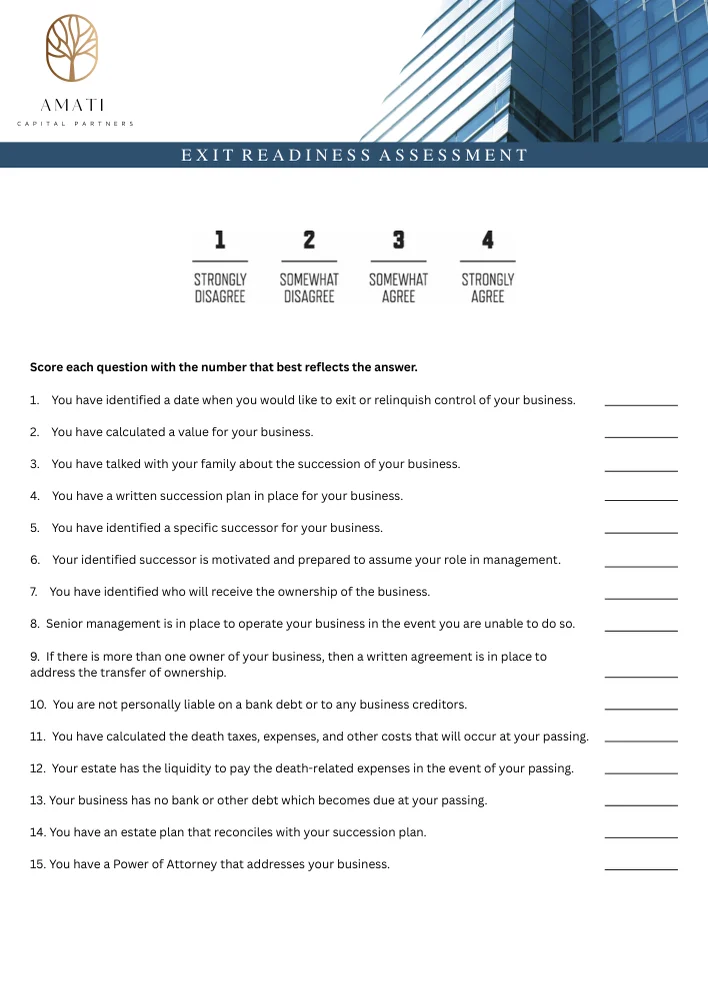
See how ready you and your business are for succession.
Assess your readinessFinancial expectations, timing, family interests, employee continuity and the owner’s future role can point toward different outcomes. We help make those priorities explicit and assess what each path would require from the company and the people involved.
A family transition may depend on successor development. A management buyout may require leadership capacity and financing. A third-party sale introduces buyer expectations and transaction demands. A leadership transition can build readiness while ownership remains in place.
A readiness assessment looks beyond the owner’s intention to leave. It examines customer relationships, decision rights, management depth, operating processes and the knowledge concentrated in a small number of people. The question is whether performance can continue through a change in leadership or ownership.
Enterprise-value improvement begins with addressing those dependencies. Clear accountability, repeatable processes and a capable management team can support continuity and give a future successor or buyer a clearer understanding of the business.
Owners need a reliable picture of earnings, working capital, capital requirements and operating performance. We identify reporting gaps and preparation priorities so that management can explain the company’s results and the resources needed to sustain them.
Governance also needs to evolve as responsibilities move. Defined approval authority, management reporting and a clear forum for ownership decisions help distinguish the owner’s role from the leadership team’s responsibilities. Improvements should fit the scale and complexity of the business.
Succession readiness strengthens the company before an ownership change. Sale execution involves a defined transaction process, buyer engagement, negotiation and completion. We help owners understand the work required at each stage and establish the next mandate when appropriate.
Preparation can include organizing business information, identifying likely diligence questions and coordinating with legal, accounting, tax and valuation advisers. Where financing is part of the transition, capital requirements and repayment capacity belong in the discussion early.
How we can help
The scope follows the owner’s objectives and the company’s starting point.
Discuss timing, financial objectives, personal involvement and potential successors. Record the priorities and uncertainties that will shape the plan.
Review owner dependence, management capacity, financial information and operational readiness. Identify gaps that could interrupt continuity or complicate a future transaction.
Develop a staged roadmap with owners for each action, decision points and a workable timetable. Focus management effort on the issues that matter most.
Review progress, coordinate specialist advisers and organize the information needed for the chosen path. Update the plan as circumstances and readiness change.
Practical deliverables
Depending on the mandate, the work can produce:
Begin while there is time to develop people, improve information and test delegated responsibilities. The work can start before an exit date is chosen; a practical timetable depends on the company’s starting position.
A preferred successor helps focus the work, but preparation can begin while options remain open. We can compare the requirements of different paths and identify improvements that support several outcomes.
Readiness work helps an owner make informed choices. A sale process requires its own decision, scope and preparation. The owner can use the resulting roadmap to support continued ownership, an internal transition or a future sale.
Practical perspectives from Amati
A practical next step
Discuss your objectives, the business’s current readiness and the decisions that need attention before the next chapter begins.
Read Henry van der Sloot's background and discuss the right scope and team for your situation.